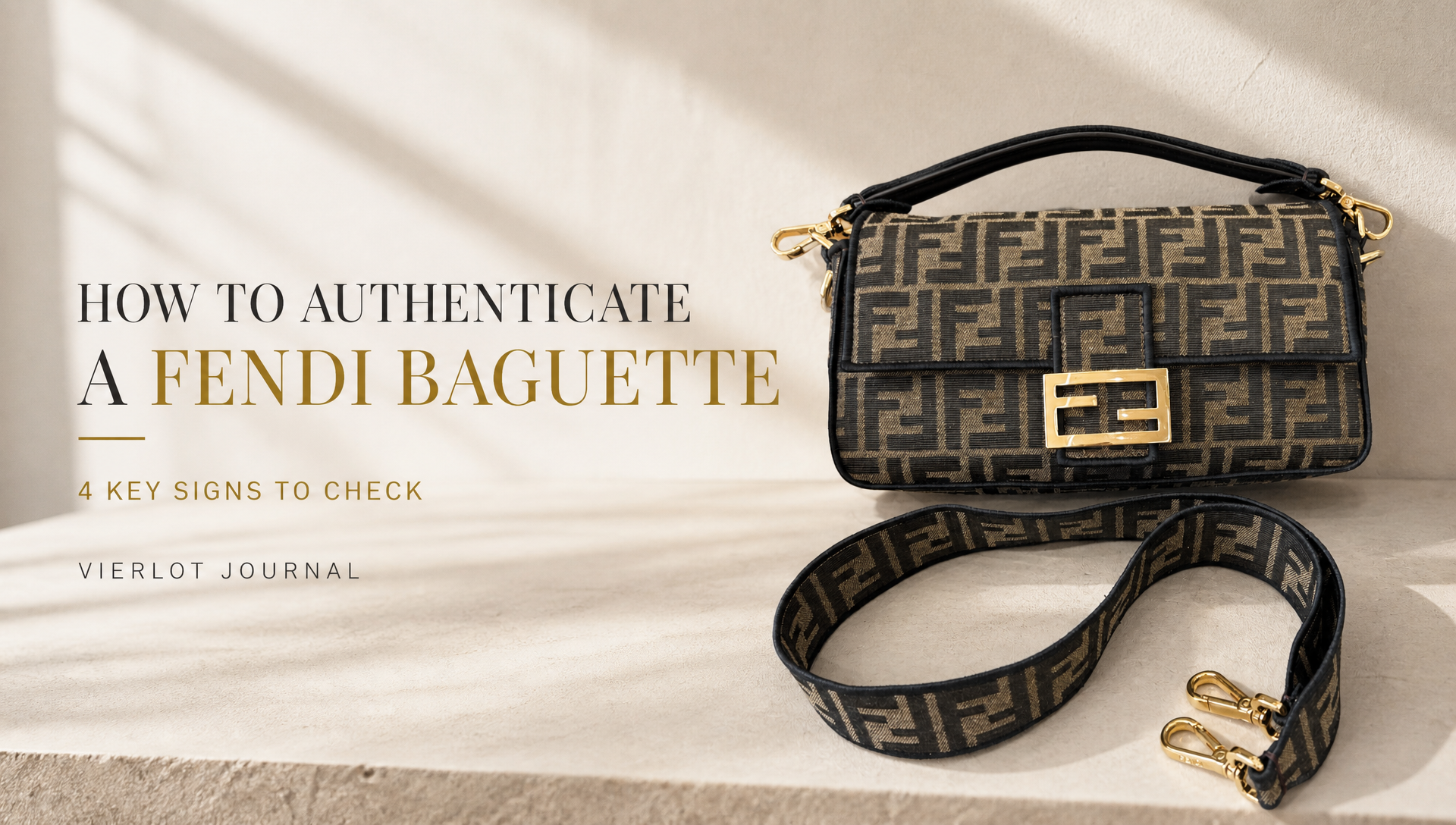
How to Authenticate a Fendi Baguette Bag: 4 Key Details to Check
Quick Takeaway:
Authenticating an iconic Fendi Baguette spans both vintage and contemporary production markers: on mid-2000s models, inspect the hologram tag’s reverse side for dense, compact embroidery rather than sparse, threadbare lettering; on modern editions, verify that the RFID fabric label features crisp, uncrowded character spacing; cross-check the 15–17 digit leather serial code for deeply debossed proprietary typography (especially the geometric contours of the number “8”); and examine all FF hardware components for clean, uniform CNC engraving free of bleeding edges or uneven plating.
“It’s not a bag. It’s a Baguette.”
Fendi’s famous phrase perfectly captures the cultural status of the brand’s most recognizable handbag. First introduced in 1997, the Fendi Baguette has since been reimagined in countless colors, materials, embellishments, and collectible editions.
More than a seasonal accessory, the Baguette has become one of fashion’s most recognizable handbag designs. Its lasting popularity, however, has also made it a frequent target for counterfeit production.
In this Fendi Baguette authentication guide, we examine four details that may help distinguish an authentic bag from a counterfeit example:
- The hologram label
- The RFID label
- The serial code
- The hardware engraving
Although these examples focus on the Fendi Baguette, the same inspection principles can also be useful when evaluating other pre-owned Fendi handbag styles.
Authentication note: No single detail should be used as the sole basis for a final conclusion. A more reliable assessment compares multiple features and takes the bag’s model, production period, condition, and provenance into account.
1. Check the Fendi Hologram Label
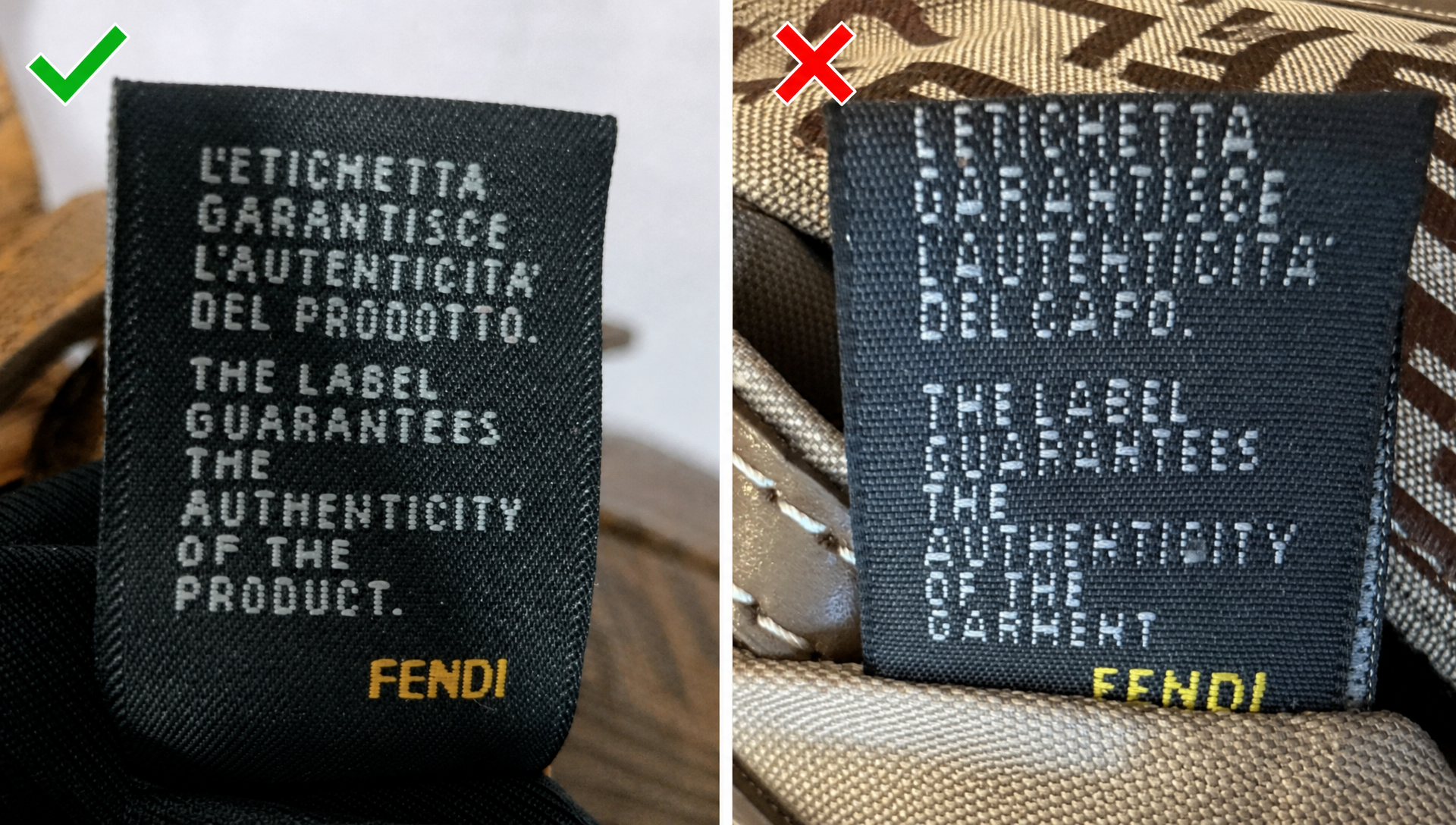
The hologram label is an important authentication point on many Fendi handbags produced from the mid-2000s onward.
It typically features a reflective surface that shifts in color under different angles of light. Depending on the bag, the hologram may be attached to a fabric label inside the interior compartment.
While the hologram itself may attract the most attention, the reverse side of the label can reveal additional clues through its stitching and embroidery.
Authentic Fendi Hologram Label
On an authentic example, inspect the reverse side of the label closely.
The embroidered lettering should appear dense, compact, and clearly formed. The stitches are generally placed closely together, allowing each letter to look full, balanced, and easy to read.
The embroidery should not appear weak, sparse, or loosely constructed. The overall label should also show a controlled and consistent level of craftsmanship that matches Fendi’s manufacturing standards.
When possible, examine the label under magnification. Fine embroidery details are often difficult to evaluate in a distant product photo.
Counterfeit Fendi Hologram Label
On a counterfeit label, the embroidery may look noticeably less dense.
Fewer stitches or wider spacing can cause the lettering to appear thin, weak, or poorly defined. The letters may lack the fullness and clarity seen on an authentic label.
A counterfeit hologram can still look convincing at first glance, especially when photographed from a distance. However, closer inspection may reveal differences in stitch density, letter formation, and overall construction.
The presence of a reflective hologram alone is not enough to confirm authenticity. Its embroidery and construction should also be consistent with the bag’s age and design.
2. Inspect the Fendi RFID Label
Fendi later introduced RFID technology across many of its products. These bags may contain a fabric label with an RFID chip discreetly sewn into the interior.
However, the presence of an RFID chip does not automatically prove that a bag is authentic. Counterfeit manufacturers can imitate the appearance of an RFID label or insert generic chips into counterfeit products.
For this reason, authentication should focus on the complete construction of the label, especially the embroidered FENDI logo.
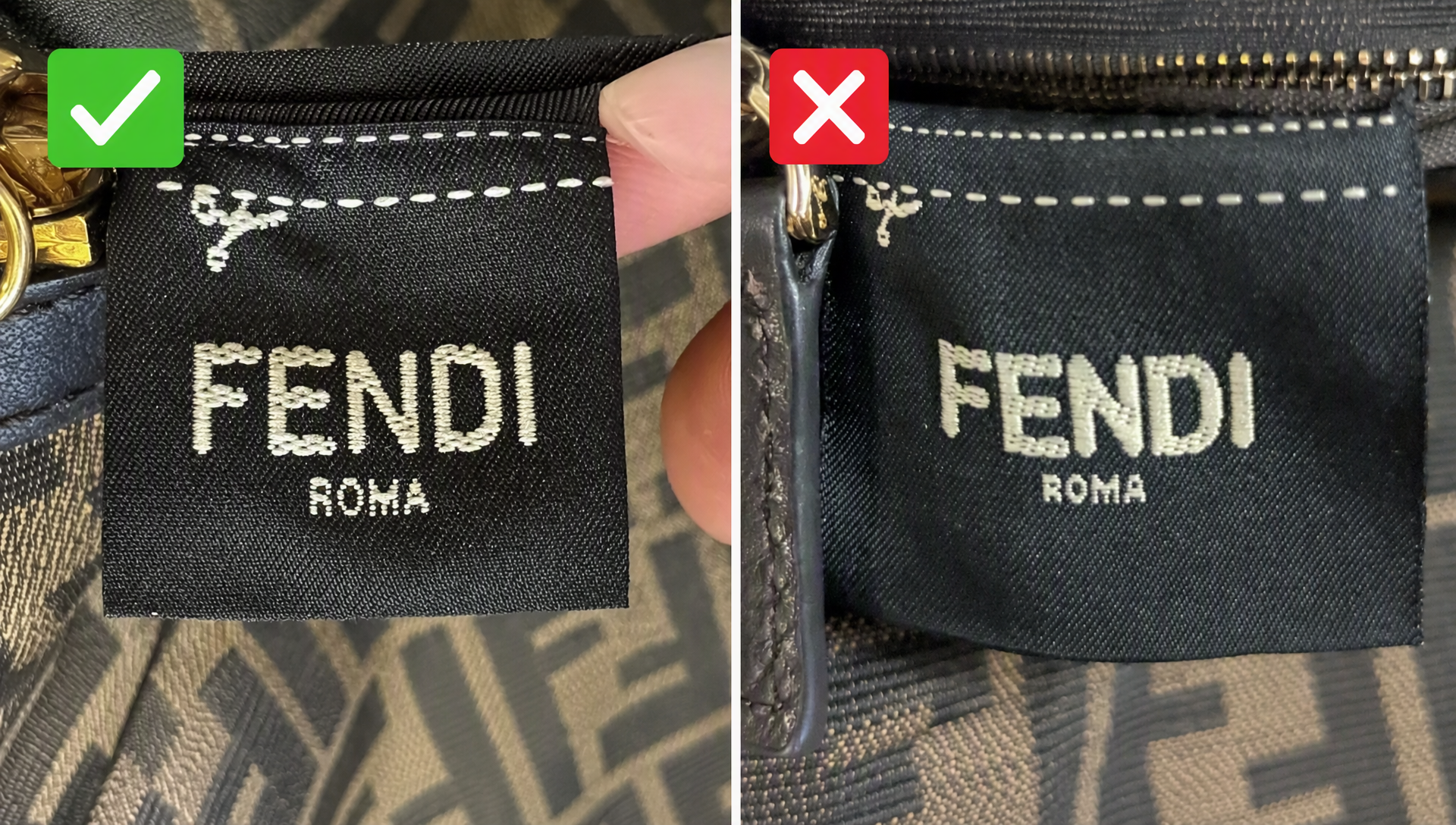
Authentic Fendi RFID Label
An authentic RFID label should feature a distinctive and carefully controlled embroidery pattern.
The letters should appear proportionate, with clean lines and appropriate spacing between each character. The edges, curves, and corners of the lettering should look intentional and consistent.
The logo should not appear overly thick, crowded, or uneven. Instead, the embroidery should have a refined appearance that matches the quality expected from an authentic Fendi product.
Counterfeit Fendi RFID Label
Counterfeit RFID labels often imitate the general appearance of the authentic version while missing the finer embroidery details.
In the replica example, the embroidered strokes appear thicker, and the letters look crowded because the spacing is too narrow. The curves and corners may also differ from Fendi’s established typography.
These issues can be difficult to identify without a clear close-up image. When reviewing an RFID label, examine the letter spacing, stitch direction, thickness, and overall shape of the embroidered logo.
An RFID chip should therefore be treated as only one part of the evaluation—not as independent proof of authenticity.
 3. Examine the Fendi Serial Code
Many Fendi handbags produced from the 1980s onward feature an alphanumeric serial code.
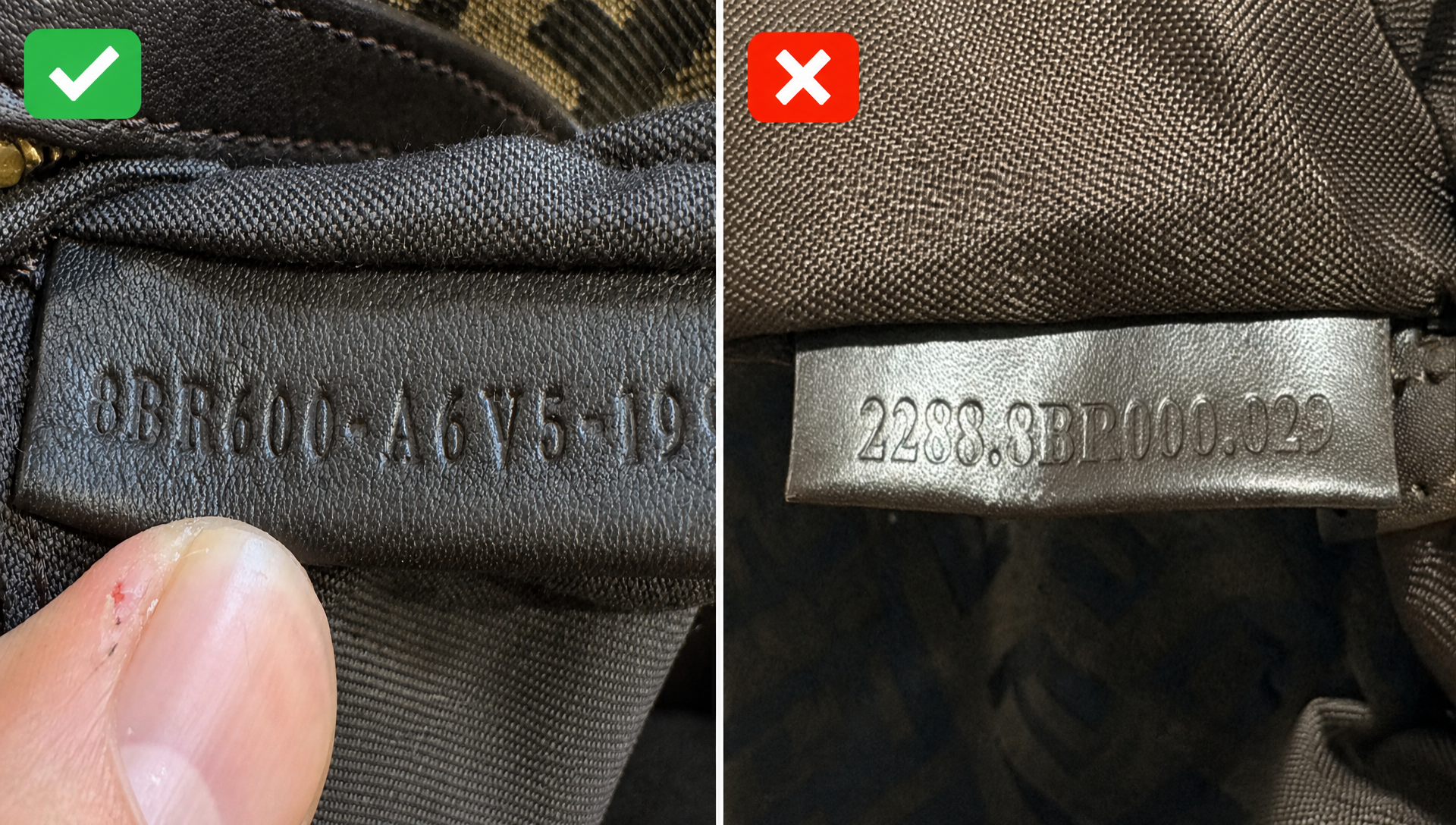
The code commonly contains approximately 15 to 17 characters and is often separated by hyphens. Depending on the model and production period, it may be located on the reverse side of a small interior leather tag or stamped onto another leather element inside the bag.
A serial code that looks structurally correct does not automatically confirm authenticity. Modern counterfeiters can reproduce plausible-looking numbers and format them to resemble genuine Fendi codes.
Instead of focusing only on the code itself, pay close attention to how it has been stamped into the leather.
Authentic Fendi Serial Code
On an authentic example, the characters should be deeply and clearly impressed into the leather.
Fendi uses distinctive shapes for certain letters and numbers, so authenticators examine individual characters rather than simply reading the code as a sequence.
The following details should be consistent with the bag’s production period:
- The depth of the impression
- The proportions of each character
- The shape of the letters and numbers
- The sharpness of the edges
- The spacing between characters
- The alignment of the code
The stamping should look deliberate and controlled. It should not appear blurry, uneven, overly shallow, or randomly positioned on the leather.
Counterfeit Fendi Serial Code
Counterfeit examples often reveal differences in stamping quality.
The impression may be too shallow, leaving the characters looking flat, weak, or poorly defined. The typeface may also contain inconsistencies that are not compatible with Fendi’s established character shapes.
For example, the number “8” in the counterfeit example does not match the expected Fendi typography. Instead, it resembles a generic computer font.
This kind of detail can be especially useful because counterfeiters may copy the format of a serial code without accurately reproducing the brand’s original stamping style.
A serial code should therefore be evaluated together with the label, stitching, hardware, and overall construction of the bag.
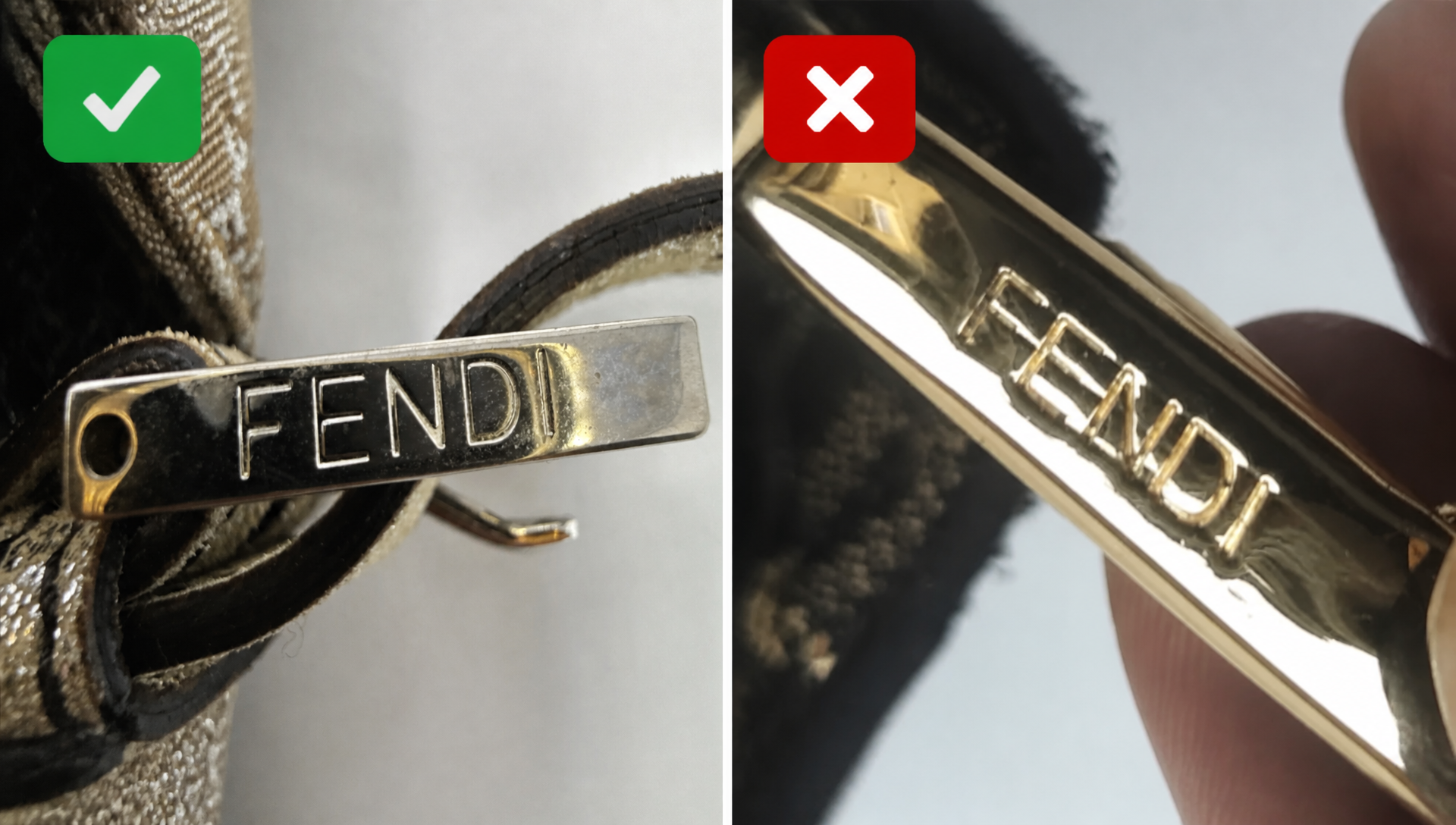
4. Check the Fendi Hardware Engraving
Every hardware component carrying a Fendi logo deserves close inspection.
Depending on the model and production period, you may find FENDI or FF branding on zipper pulls, buckles, clasps, rings, plaques, studs, and other metal components.
Because hardware is often photographed under changing lighting conditions, color and shine should not be the only focus. The clarity, depth, spacing, and finishing of the engraving can provide more useful information.
Authentic Fendi Hardware
On an authentic Fendi handbag, engraved lettering should generally appear sharp, clean, and consistent with the brand’s typography.
The characters should be properly spaced and clearly separated. Each letter should have a defined shape instead of merging into the neighboring characters.
The recessed areas of the engraving should also be well finished, without obvious debris, rough edges, uncontrolled marks, or uneven depths.
In other words, do not look only at what the engraving says. Examine how the engraving was made.
Authentic hardware should typically show:
- Clean and defined lettering
- Consistent engraving depth
- Even spacing between characters
- Smooth and controlled edges
- A uniform metal finish
- Well-shaped hardware components
Counterfeit Fendi Hardware
Replica hardware often reveals differences in both engraving quality and material finishing.
In the counterfeit example, the engraved lettering lacks definition. Some letters appear to run into one another instead of remaining crisp and individually formed.
The metal surface may also look uneven or poorly finished. Rough edges, inconsistent texture, and an imprecise engraving style can suggest lower-quality materials and manufacturing processes.
When evaluating Fendi hardware, compare the engraving with other branded details on the bag. The typography, depth, spacing, and finishing should look consistent across the different components.
Final Thoughts
Authenticating a Fendi Baguette requires more than checking whether the bag has the correct shape or recognizable logo.
The interior hologram label can reveal differences in embroidery density and letter formation. The RFID label should be evaluated through its complete construction rather than the presence of a chip alone.
The serial code should be examined for stamping depth, character shape, spacing, and typography. Finally, branded hardware can provide useful clues through the quality and precision of its engraving.
These details should always be considered together. Production methods can vary between different Fendi collections, materials, and years, while wear and photography can also affect the appearance of a pre-owned bag.
For a more reliable assessment, request clear close-up photographs of the interior labels, serial code, hardware, stitching, and other key construction details before making a purchase.
Looking for an Authenticated Pre-Owned Fendi Baguette?
Explore Vierlot’s carefully curated selection of authenticated pre-owned luxury handbags.
Related Guides:
[Designer Bag Authentication Guide] · [Fendi Buying Guide] · [Luxury Handbag Care Guide]