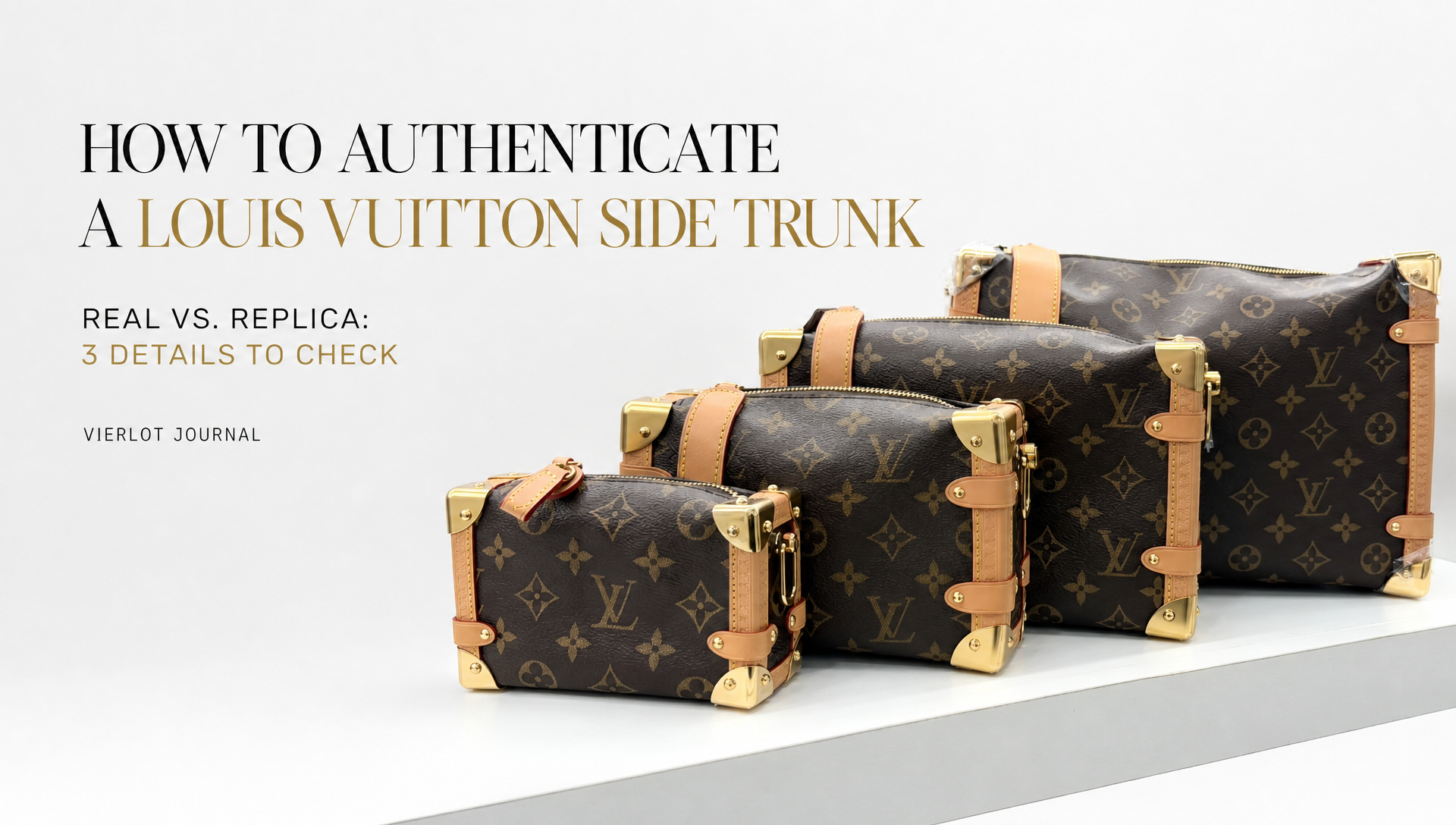
How to Authenticate a Louis Vuitton Side Trunk: 3 Details to Check
Quick Takeaway:
Authenticating a Louis Vuitton Side Trunk relies on verifying microscopic structural and typographic precision: the interior leather label requires an uncrowded brand stamp with a circled “®” symbol proportioned strictly to match the “O” in VUITTON; the overlapping LV side impressions must display an angled diagonal terminal at the bottom-left base of the “L”; and the zipper slider must feature a deliberate, recessed hexagonal indentation on its top surface rather than a smooth, flat counterfeit plate.
Inspired by Louis Vuitton’s historic trunkmaking tradition, the Side Trunk combines a structured silhouette with reinforced corners, a leather zipper tab, and the brand’s signature S-lock hardware.
These distinctive design elements make the bag easy to recognize, but they have also made the Side Trunk a popular target for counterfeiters. Some replicas can look convincing in online listings, especially when sellers provide only distant photos or limited views of the bag.
A closer inspection may reveal inconsistencies in the typography, stitching, logo geometry, and hardware construction.
In this guide, we examine three details that may help when comparing an authentic Louis Vuitton Side Trunk with a replica:
- The interior Louis Vuitton logo label
- The overlapping LV logo stamps
- The zipper construction and craftsmanship
Authentication note: No single detail should be used as the only basis for a final conclusion. A more reliable assessment should compare several features together and take the bag’s overall construction, condition, provenance, and available documentation into account.
1. Examine the Interior Louis Vuitton Logo Label
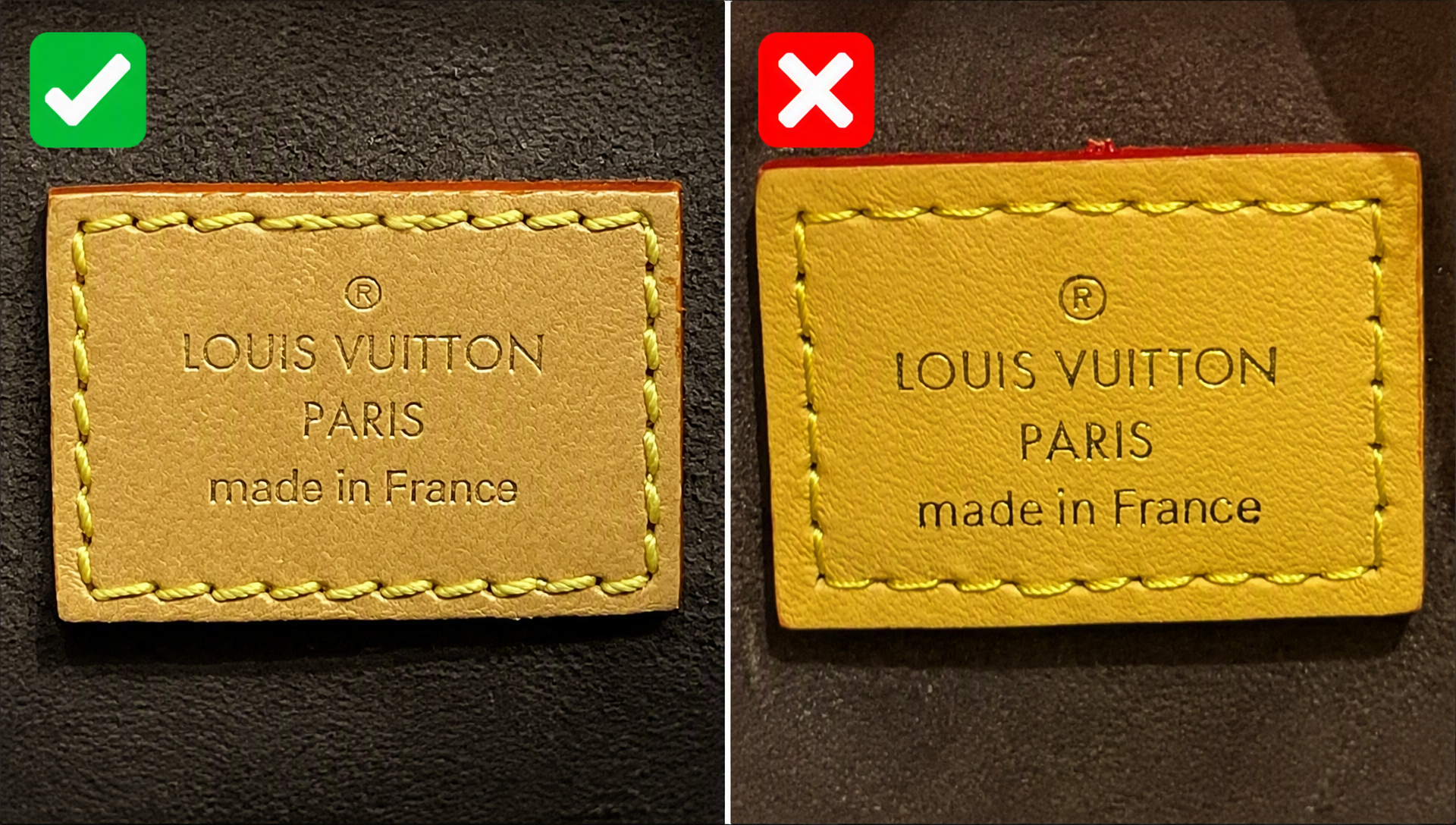
The interior Louis Vuitton logo label may look simple, but its stitching and embossed lettering can provide useful authentication clues.
Counterfeit manufacturers often reproduce the correct brand wording while overlooking the precise proportions, spacing, and finishing quality of an authentic Louis Vuitton label.
What to Look for on an Authentic Logo Label
Clean and Even Stitching
An authentic label should be secured with neat, evenly spaced stitches. The thread should have an appropriate thickness, and the stitch line should follow the edges of the leather label in a controlled and consistent manner.
The stitching should look precise and deliberate rather than loose, irregular, or poorly aligned.
Correctly Proportioned Registered Trademark Symbol
Pay close attention to the registered trademark symbol beside the Louis Vuitton logo.
On an authentic logo stamp, the circle surrounding the “R” should be carefully proportioned. Its size should appear approximately similar to the “O” in “LOUIS VUITTON” below it.
The symbol should feel integrated into the overall logo. It should not appear oversized or visually heavier than the surrounding lettering.
Balanced Logo Scale
The complete Louis Vuitton stamp should be properly balanced in relation to the leather label. The embossed letters should be clear and evenly spaced without looking oversized, crowded, or compressed.
The logo should sit naturally within the label, with an appropriate amount of space around the lettering.
Common Issues on a Replica Logo Label
Thin or Uneven Stitching
On the replica example, the thread appears noticeably thinner. The stitches may also be irregular, unevenly spaced, or poorly aligned with the edges of the leather label.
These inconsistencies can make the label appear less refined than the rest of the bag.
Oversized Circled “R”
An oversized registered trademark symbol can be an important warning sign.
On the replica label, the circle around the “R” is significantly larger than the “O” in “LOUIS VUITTON.” This disrupts the balance of the logo and makes the trademark symbol look too prominent.
Logo That Is Too Large
The entire Louis Vuitton stamp on the replica may appear oversized in relation to the leather label. This can compress the spacing between the letters and create an unbalanced appearance.
When examining the label, do not focus only on whether the wording is spelled correctly. Also consider:
- The overall scale of the logo
- The spacing between the letters
- The size of the trademark symbol
- The clarity of the embossing
- The amount of space around the stamp
- The relationship between the logo and the leather label
2. Inspect the Overlapping LV Logo Stamps
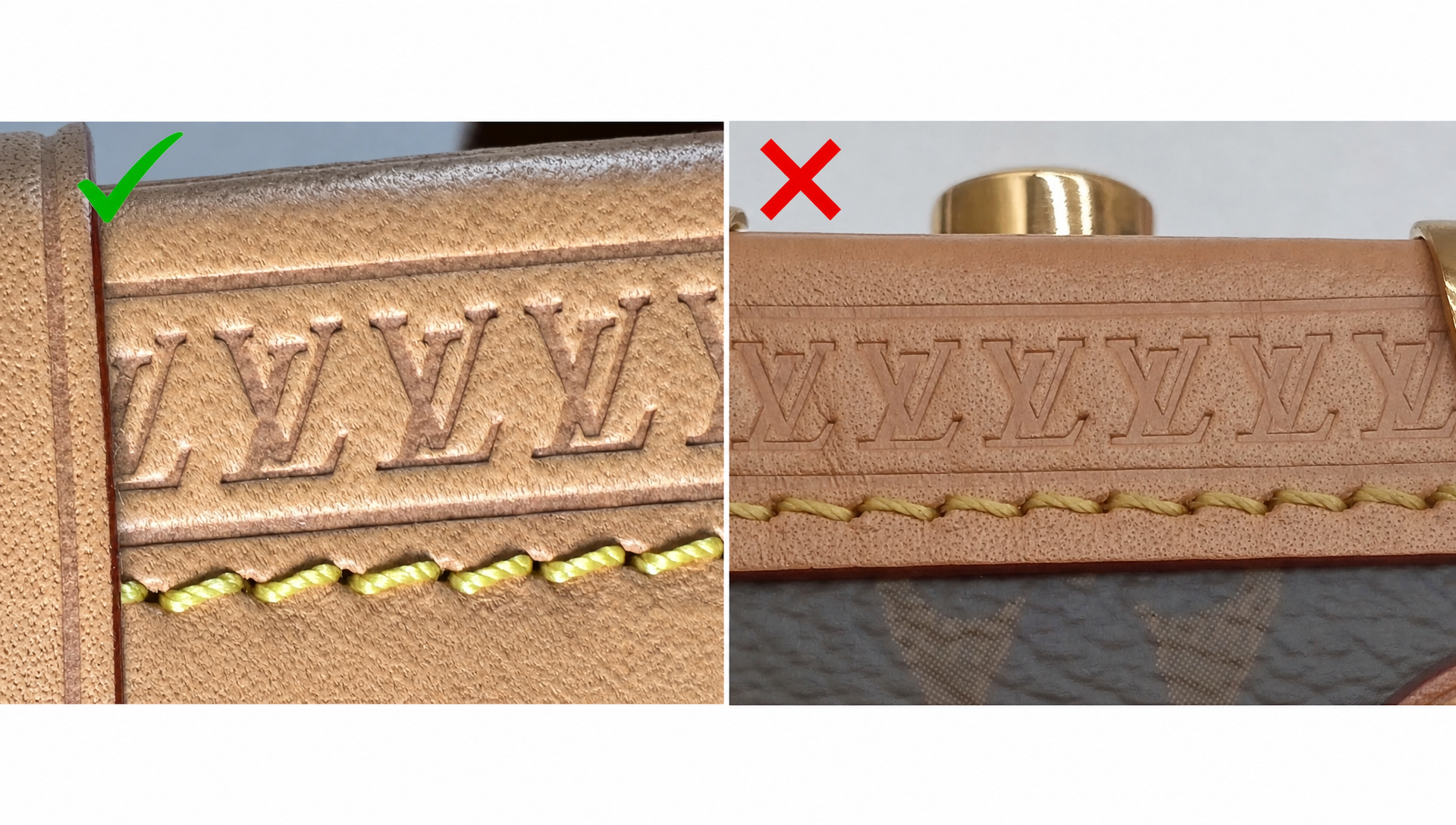
A distinctive feature of the Side Trunk is the series of overlapping LV impressions along its leather side trim.
Any area displaying a brand logo deserves close attention during authentication. Even a small typographic or geometric error can indicate that the logo was not reproduced accurately.
Features of Authentic LV Stamps
An authentic impression should follow Louis Vuitton’s standard LV letterforms. The letters should have the correct height, proportions, and geometry.
Although the impressions overlap along the leather trim, the design should remain clear and visually balanced. The letters should not look unusually short, compressed, or distorted.
Look Closely at the Bottom of the “L”
One subtle but useful detail can be found on the bottom of the “L.”
On an authentic LV stamp, the short terminal at the far-left side of the bottom line is angled rather than completely vertical. This small diagonal feature forms part of the correct geometry of the Louis Vuitton logo.
Because the difference is subtle, a sharp close-up is essential. A distant marketplace photo may not provide enough detail to evaluate this part of the logo accurately.
Common Issues on Replica LV Stamps
On the replica example, the LV letters appear shorter and more compressed. The impression may resemble the authentic version at first glance, but the proportions do not match the original letterforms.
Incorrect Geometry on the “L”
The construction of the “L” provides an especially useful clue.
Instead of the correct angled terminal on the far-left side of the bottom line, the replica uses a straight vertical edge. This small geometric error can reveal that the LV logo was copied inaccurately.
When comparing the overlapping LV stamps, examine:
- The height of the letters
- The proportions of the LV monogram
- The clarity of the overlapping impressions
- The shape of the bottom-left terminal on the “L”
- The definition and consistency of the embossed edges
These details are often more useful than simply deciding whether the logo looks generally familiar.
3. Check the Zipper Construction and Craftsmanship
Hardware is another important part of Louis Vuitton authentication. Even a small zipper component can reveal differences in construction, shaping, and finishing quality.
When reviewing hardware, focus on its physical structure rather than relying only on color or shine. Lighting, reflections, camera settings, and normal wear can all affect how metal appears in photographs.
Features of an Authentic Louis Vuitton Zipper
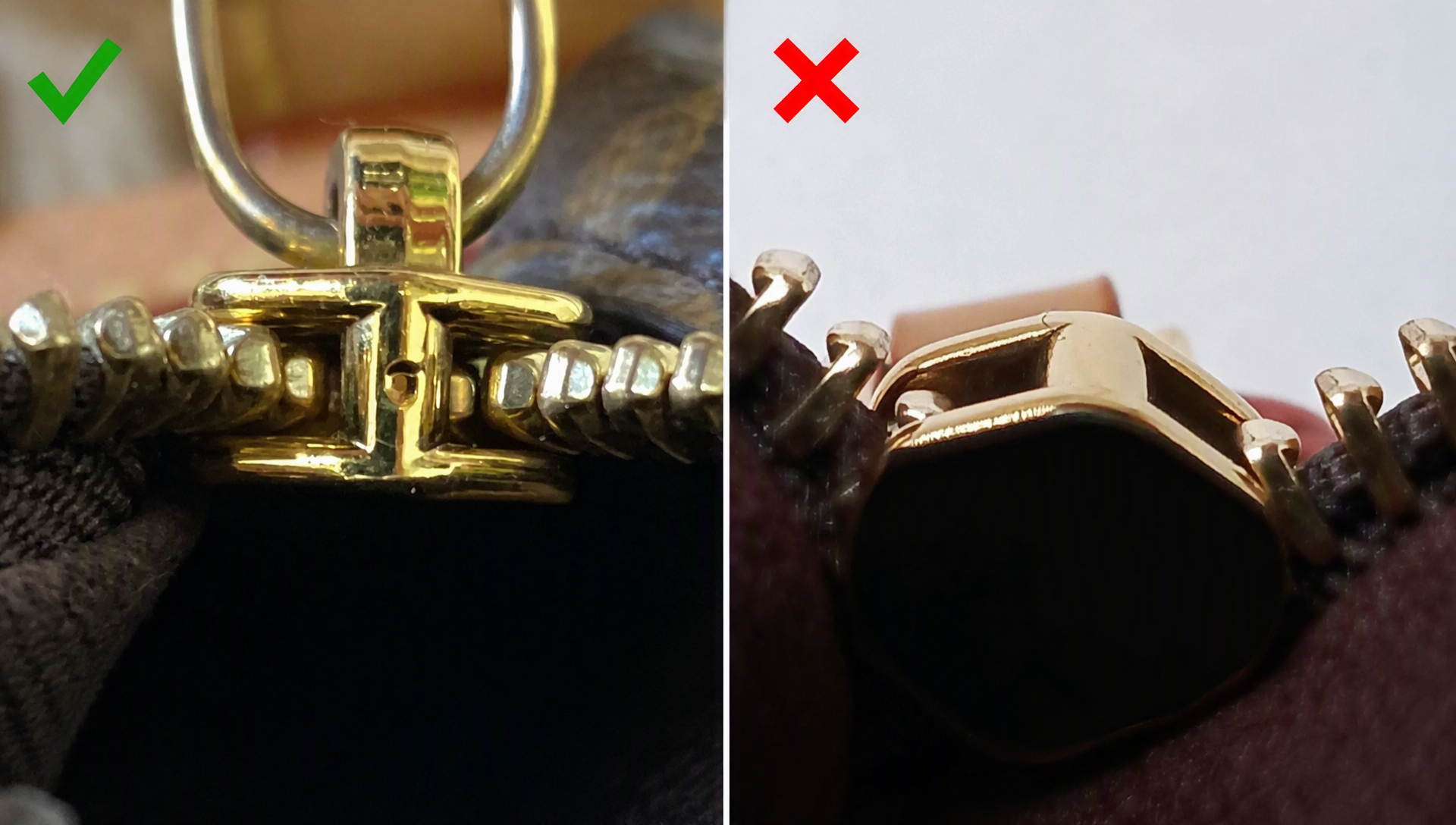
At the top of the authentic zipper slider, there is a recessed hexagonal detail.
This indentation is deliberately formed and gives the component a more complex and precisely engineered appearance. It is not simply a flat surface with a different finish.
The authentic hardware should also have clean edges and a consistent finish. Each part should appear carefully shaped, with defined contours and a controlled overall construction.
The recessed detail is especially useful because it reflects the physical structure of the zipper slider rather than only its surface appearance.
Common Issues on a Replica Zipper
On the replica zipper, the same top surface is completely flat. It lacks the recessed hexagonal construction found on the authentic component.
This difference may be difficult to identify in distant marketplace photos, particularly when the zipper is partially hidden or photographed from an unhelpful angle.
Whenever possible, request sharp close-up photos of the zipper from multiple angles. One blurry image may not be enough to determine whether the top of the slider is recessed or flat.
When evaluating the zipper, prioritize structural details such as:
- The shape of the zipper slider
- Whether the top surface is recessed or flat
- The definition of the edges
- The consistency of the metal finish
- The way the individual components are assembled
Structural features are generally more useful than color or shine. These visual qualities can vary because of lighting, camera settings, reflections, and normal wear.
Final Thoughts
When authenticating a Louis Vuitton Side Trunk, some of the most useful clues appear in small construction details rather than in the bag’s overall silhouette.
Start with the interior logo label. Examine the stitching, the registered trademark symbol, the scale of the Louis Vuitton stamp, and the spacing between the embossed letters.
Next, inspect the overlapping LV impressions on the leather side trim. Pay particular attention to the letter proportions and the angled terminal at the bottom of the “L.”
Finally, examine the zipper slider from multiple angles. The recessed hexagonal detail on the top of the authentic zipper is an important structural feature to compare with the flat surface often seen on a replica.
No single feature should determine the result on its own. For a more reliable assessment, compare multiple details and request high-resolution photos of the interior label, side stamps, zipper, hardware, identification details, stitching, and overall construction.
Looking for an Authenticated Pre-Owned Louis Vuitton Side Trunk?
Explore Vierlot’s carefully curated selection of authenticated pre-owned luxury handbags.
Related Guides:
[Designer Bag Authentication Guide] · [Louis Vuitton Buying Guide] · [Luxury Handbag Care Guide]